







View details
Wedge wire screen
1793243424000
How Do Wedge-Wire Screen Tubes Filter? Structural Composition and Fluid-Flow Principles
Online


Send email


Product details
sieve tube
≥99.5%
Filtration efficiency
≤10 mg/m³
Outlet concentration
Equipment Introduction
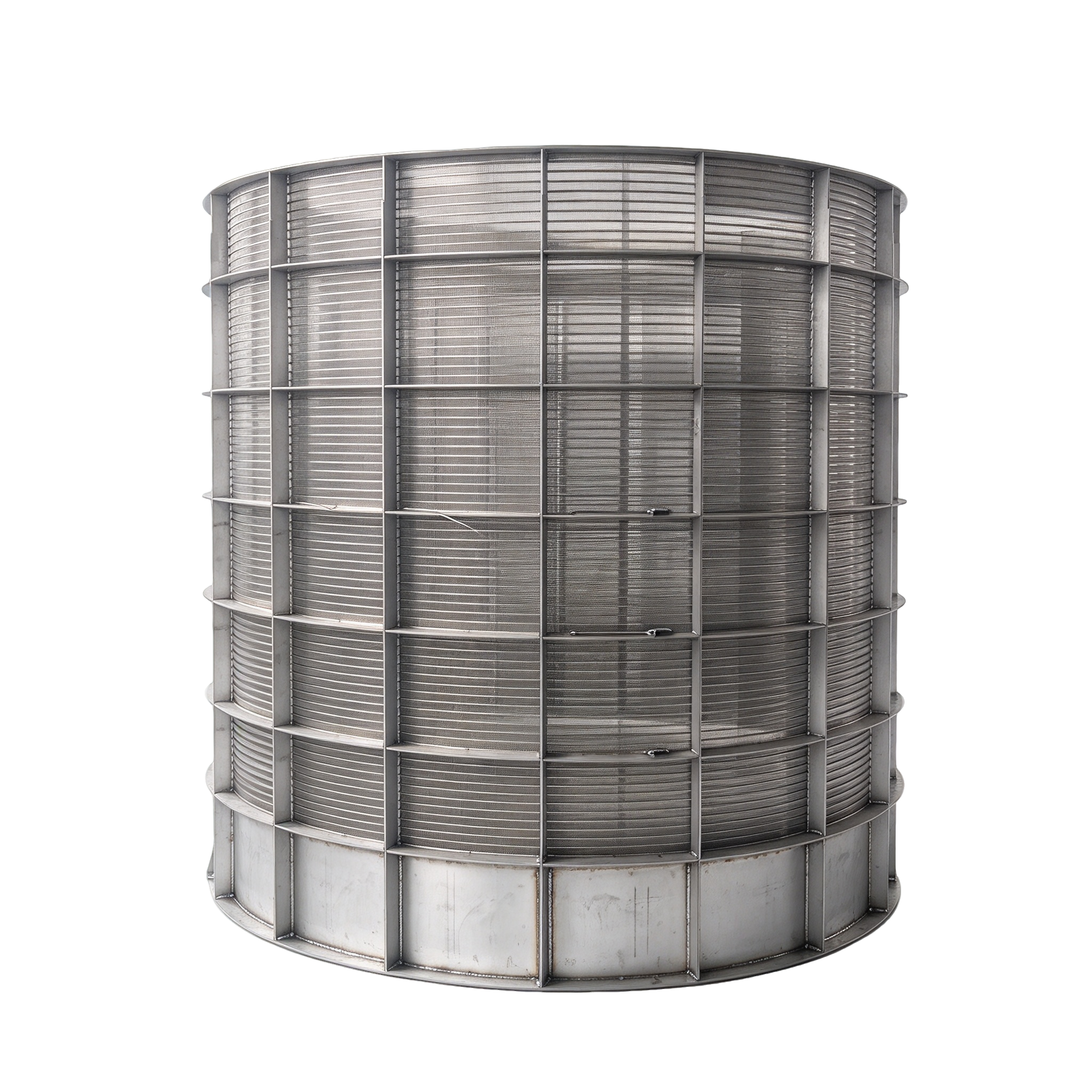
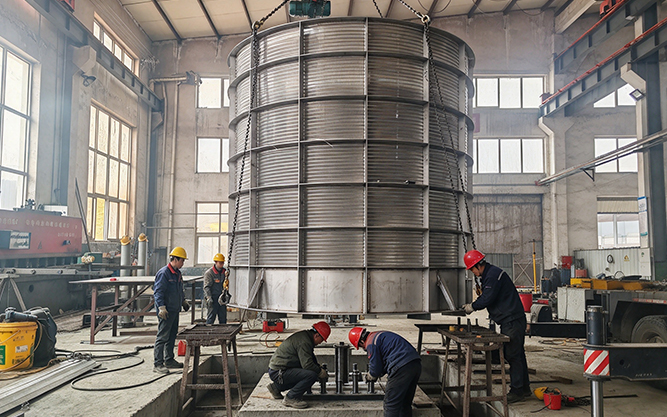
Wedge-wire screen cylinders are fully welded, cylindrical filtration elements. They are constructed by continuously wrapping a V-shaped (trapezoidal) profile wire around a series of axial support rods and securing it via resistance welding. This process creates a uniform, continuous slot that is wider on the outside and narrower on the inside. These screens are primarily used within tanks, pressure vessels, and filter towers for applications such as water collection and distribution, resin retention, sand control, fluid flow distribution, and solid-liquid separation. They are widely integrated into equipment such as resin tanks, adsorption towers, water treatment filters, and distillation column internals, serving as a core cylindrical filtration component in chemical processing, water treatment, and environmental protection systems.
Structural Features
Typically constructed by winding wedge-shaped wire into a cylindrical, hollow tubular form.
The support structure—consisting of ribs or support rods—is welded to the wedge-shaped wire to create precise gaps.
These gaps are generally oriented longitudinally (along the length of the screen tube).
Capable of withstanding high pressures and flow rates, these screens are widely used in applications such as well operations, filtration, and separation.
Primary Uses
Fluid filtration (e.g., water, chemical liquids, crude oil, etc.).
Solid-liquid separation and filtration of mixed fluids.
Sand control: preventing particles from entering pipelines during downhole operations.
Downhole filtration devices for fluid extraction (in deep water wells, mines, etc.).
Application Scenarios
Water treatment: Filter pipes for surface water and groundwater, and drinking water treatment.
Oil and gas: Sand-control filter pipes for underground wells.
Chemical industry: Processing of reaction product streams (e.g., filtration of media containing sand or particulates).
Mining and metallurgy: Filtration of reclaimed wastewater and mineral slurries.
Agricultural irrigation: Well pipes for farmland irrigation.
Energy sector: Filter pipes for thermal power plants and new energy projects.
Common Materials
Stainless steel series: 304, 304L, 316, and 316L (the most common types; offer good corrosion and wear resistance; suitable for applications such as water treatment and food & beverage processing).
Duplex stainless steel: Used in environments requiring higher corrosion resistance, such as seawater filtration.
Special alloys: Including Hastelloy and Inconel; used in high-temperature and highly corrosive environments.
Carbon steel: An economical choice for applications with low corrosion risk; requires surface anti-corrosion treatment.
advantage
Precise slot design traps solid particles, effectively preventing pipeline clogs.
Excellent resistance to pressure and corrosion (typically constructed from stainless steel, such as grades 304 or 316L).
Highly adaptable; suitable for environments with high pressure and high flow rates.
Long service life, economical, and environmentally friendly.
Product Format
Standard screen pipes: Suitable for general filtration purposes.
Bridge-slotted screen pipes: Used for downhole operations.
Pre-packed screen pipes: Equipped with additional sand-control media (such as quartz sand) for more efficient sand-control filtration.
Multi-layer screen pipes: Feature a multi-layered structure, suitable for more complex, high-precision filtration requirements.
Table of Standard Specifications
|
model |
Outer diameter (mm) |
Length (mm) |
Gap mm |
Perforation rate |
Number of supporting bars |
Common Materials |
|
JW P Φ100 |
100 |
1000 6000 |
0.1 1.0 |
10% 25% |
6 8 |
SS304/SS316L |
|
JW P Φ200 |
200 |
1000 6000 |
0.1 2.0 |
12% 30% |
8 12 |
SS304/SS316L |
|
JW P Φ300 |
300 |
1000 6000 |
0.2 3.0 |
15% 35% |
10 16 |
SS304/SS316L / Duplex steel |
|
JW P Φ500 |
500 |
1000 6000 |
0.3 5.0 |
18% 40% |
12 20 |
SS304/SS316L |
|
JW P Φ800 |
800 |
1000 6000 |
0.5 8.0 |
20% 45% |
16 24 |
SS304 / Rubber-lined carbon steel |
|
JW P Φ1000 |
1000 |
1000 6000 |
0.5 10.0 |
20% 50% |
20 30 |
SS304 / Rubber-lined carbon steel |
|
JW P Φ1500 |
1500 |
1000 6000 |
1.0 15.0 |
25% 55% |
24 36 |
SS304 / Rubber-lined carbon steel |
Related articles
Wedge wire screen
1793243424000
How Do Wedge-Wire Screen Tubes Filter? Structural Composition and Fluid-Flow Principles
Wedge wire screen
1793243401000
How to Select Slot Size and Open Area for Wedge Wire Screen Tubes? Specification and Parameter Guide
Wedge wire screen
1793243379000
What types of wedge-wire screen pipes are there? Standard screen pipes, sand-control screen pipes, and multi-layer structures.
OEM
Customized for your process conditions
Get a tailored solution
FAQs
We could not find what you need. Please contact our team.
View details
Which parameters can be customized for screen pipes?
Specifications may encompass outer diameter, length, slot size, open area ratio, number of support ribs, and material. Standard outer diameters typically range from 100 to 1500 mm, with lengths between 1000 and 6000 mm. For custom orders, it is recommended to provide equipment connection dimensions, filtration objectives, media conditions, and installation drawings.
What are the product forms of wedge-wire screen tubes?
The types listed include standard screen pipes, bridge-slotted screen pipes, pre-packed screen pipes, and multi-layer screen pipes. Each type features a different structure and is suited to different applications; determining whether a specific type is appropriate for a given filtration task requires considering both particle control requirements and the intended installation method.
What materials are available for screen pipes?
Common materials include 304, 304L, 316, and 316L stainless steel; depending on operating conditions, options such as duplex stainless steel, special alloys, or carbon steel with anti-corrosion treatments may also be evaluated. When selecting materials, it is essential to define the composition of the medium, temperature, corrosivity, and wear conditions, and to verify the suitability of the chosen material for the specific operating environment.
How should the slot width for a screen pipe be selected?
The slot size should be determined based on the dimensions of the particles to be retained, the medium being processed, and the specific filtration requirements. Typical slot sizes range from 0.1 to 15 mm, with the applicable range varying according to the outer diameter of the component. Final selection should also take into account the open area ratio, flow rate, and the structural design of the screen pipe.
In what types of equipment and industries are wedge-wire screen tubes primarily used?
It can be used in conjunction with resin tanks, adsorption towers, water treatment filters, and various tower internals. It is also suitable for applications in water treatment, the chemical industry, mining and metallurgy, oil and gas, and agricultural irrigation. Specific suitability should be determined based on the medium, particle characteristics, and equipment design.
What is a wedge-wire screen?
Wedge-wire screen tubes are cylindrical filtering elements constructed by continuously winding a V-shaped profile wire around axial support rods and welding it in place, creating a continuous slot that is wider on the outside and narrower on the inside. These screens can be installed within tanks, filters, or towers for applications such as filtration, water collection and distribution, resin retention, and solid-liquid separation.


Contact us
If you have questions or need help, contact our team for dedicated support.
We look forward to hearing from you
Submit
Online
Send email