







View details
Heat exchanger
1793243149000
How Do Finned Heat Exchangers Transfer Heat? Principles of Air Heating, Cooling, and Waste Heat Recovery
Online


Send email


Product details
Finned heat exchanger
≥99.5%
Filtration efficiency
≤10 mg/m³
Outlet concentration
Equipment Introduction
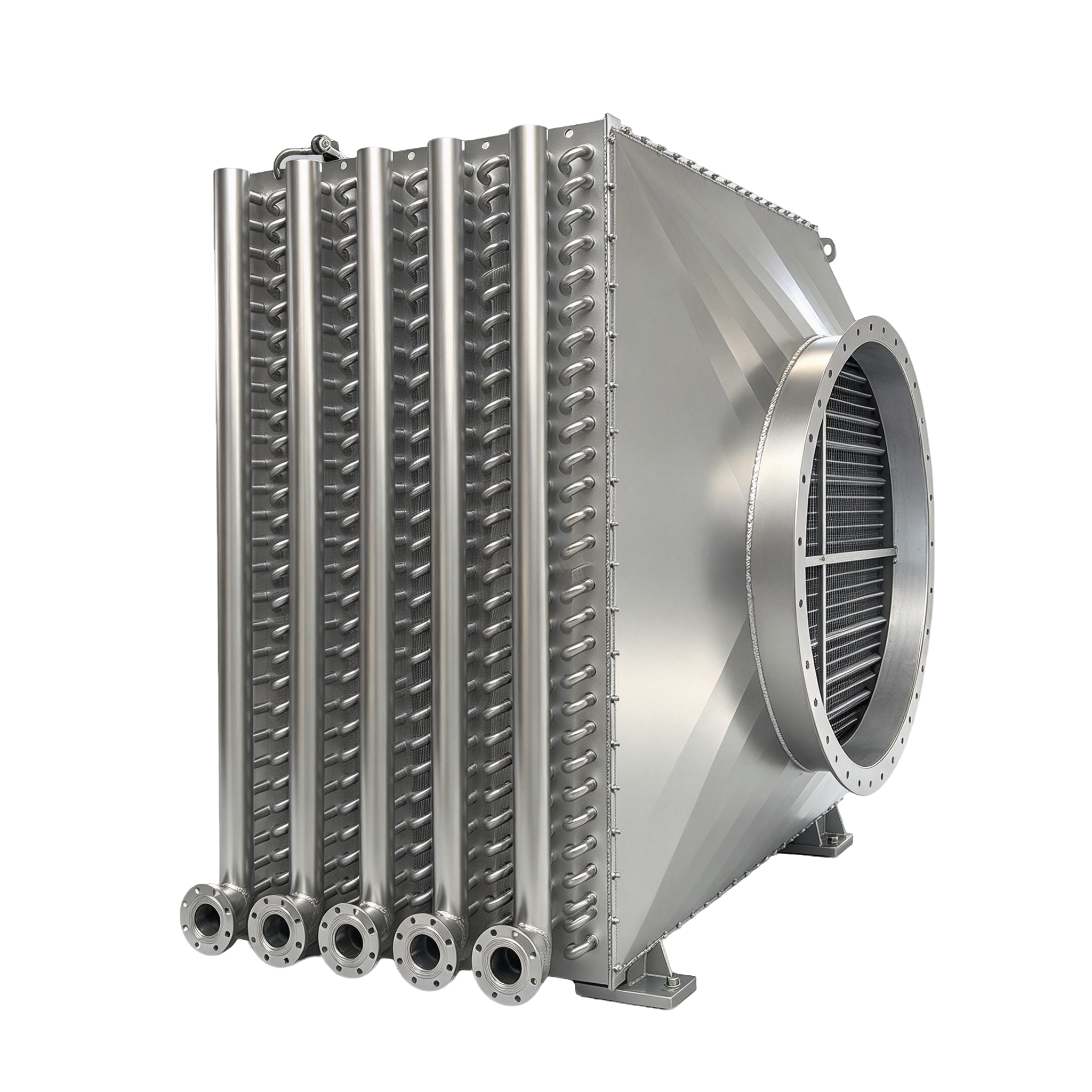
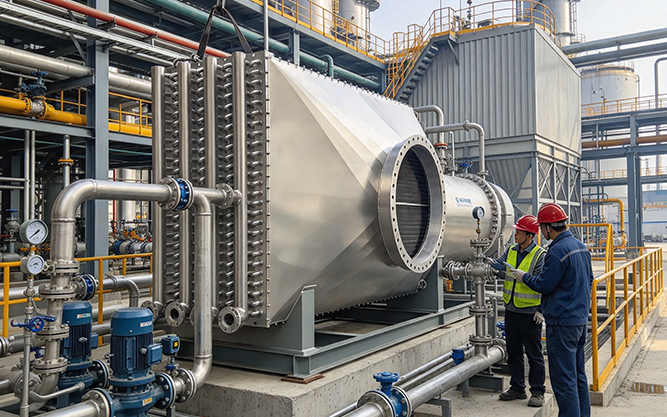
A finned heat exchanger is a highly efficient heat exchange device that increases heat transfer surface area and enhances convective heat transfer on the air side by incorporating fins onto the outer surfaces of heat exchange tubes. Primarily used for heat exchange between gas and liquid or gas and vapor, it facilitates air heating, air cooling, or the recovery of waste heat from flue gases. It serves as a core heat exchange component in fields such as industrial drying, HVAC (heating, ventilation, and air conditioning), and waste heat utilization.
Working Principle
A heating medium—such as saturated steam, hot water, or thermal oil—flows through heat-exchange tubes, transferring heat via the tube walls to the external fins. Driven by a fan, air sweeps across the finned tube bundle, undergoing forced convective heat exchange with both the fins and the tube walls; the air is heated and then discharged. Conversely, the system can be used to cool air by circulating a cooling medium through the tubes. The fins significantly expand the heat-exchange surface area on the air side—increasing it to as much as 8–25 times that of a plain tube—which effectively compensates for the fact that the air-side heat-transfer coefficient is much lower than that of the fluid inside the tubes, thereby substantially enhancing overall heat-transfer efficiency.
Applicable Operating Conditions
Air Heating: Uses steam, hot water, or thermal oil to heat air for applications such as drying, space heating, and curing.
Flue Gas Waste Heat Recovery: Recovers heat from boiler or kiln flue gas to preheat combustion air or heat water (via economizers or air preheaters).
Air Cooling: Circulates cold water or refrigerant through the tubes to cool process air or condense organic vapors.
Operating Temperature: -20°C to 400°C (depending on the materials used).
Operating Pressure: ≤1.6 MPa on the tube side (high-pressure versions available upon request).
Heat Transfer Area: 10–500 m² per unit; units can be configured in parallel or series.
Application Areas
Applications include textile setting and drying, food baking, timber drying, chemical reactions, power-related energy conservation, waste heat recovery in metallurgy, HVAC (air heaters/coolers), greenhouse heating, mine heating, and grain drying.
Product Advantages
High heat transfer efficiency: The extended surface area provided by the fins is 8–25 times that of plain tubes, with an overall heat transfer coefficient (K-value) reaching 30–80 W/(m²·K).
Compact structure: Offers a large heat exchange surface area per unit volume, saving installation space.
Flexible material combinations: Heat exchange tubes and fins can be made from different materials, allowing for adaptation to various corrosive environments and temperature conditions.
Customized design: Fin spacing, the number of tube rows, and the number of tube passes can be optimized based on specific heat transfer capacity and pressure drop requirements.
Reliable operation: Utilizes fully welded or mechanically expanded joints, ensuring a leak-free system with minimal maintenance needs.
Significant energy savings: When used for flue gas waste heat recovery, it can achieve energy savings of 10%–30%.
Material Selection Table
|
part |
Available materials |
Temperature range |
Applicable Operating Conditions |
|
Heat exchange tube |
304 stainless steel |
-20~400℃ |
General industrial heat exchange, food-grade, mildly corrosive |
|
Heat exchange tube |
316L stainless steel |
-20~400℃ |
Chemical operating conditions involving chloride ions and high corrosivity |
|
Heat exchange tube |
Carbon steel (Q235) |
-20~350℃ |
Standard air heating, drying, and cost-sensitive applications |
|
fins |
Aluminum fins / Stainless steel fins / Copper fins |
By material |
Aluminum fins offer the best value for money, while stainless steel fins provide resistance to high-temperature corrosion. |
|
Tube Box/Frame |
Carbon steel / 304 / 316L stainless steel |
By material |
Select based on the corrosiveness of the medium and appearance requirements. |
Note: All the aforementioned products can be custom-designed and manufactured to suit specific operating conditions and project requirements. For technical selection assistance or a price quote, please provide details such as the required airflow volume or heat transfer capacity, the composition and temperature of the medium, and the available installation space. We will then provide you with a professional solution.
Related articles
Heat exchanger
1793243149000
How Do Finned Heat Exchangers Transfer Heat? Principles of Air Heating, Cooling, and Waste Heat Recovery
Heat exchanger
1793243044000
How to Select a Finned Heat Exchanger? An Explanation of Heat Transfer Capacity, Airflow, and Structural Parameters
Heat exchanger
1793243025000
How to Select Materials for Finned Heat Exchangers? Considerations for Heat Exchanger Tube and Fin Configurations
OEM
Customized for your process conditions
Get a tailored solution
FAQs
We could not find what you need. Please contact our team.
View details
What are the temperature and pressure ranges for finned-tube heat exchangers?
The operating temperature range is -20°C to 400°C, with a tube-side pressure of ≤1.6 MPa; high-pressure versions can also be customized. The specific scope of application depends on the materials, construction, and design conditions; the final parameters shall be as specified in the project design documentation.
What materials can be chosen for heat exchanger tubes and fins?
Heat exchanger tubes can be made of 304 or 316L stainless steel, or carbon steel; fins can be made of aluminum, stainless steel, or copper. Since different materials vary in terms of temperature suitability, corrosion resistance, and cost, the choice should be determined based on the media inside and outside the tubes, operating temperatures, and specific project requirements.
What parameters need to be provided for model selection?
It is recommended to provide the following information: airflow rate or required heat transfer capacity, air inlet and outlet temperatures, the medium inside the tubes along with its inlet and outlet temperatures, operating pressure, medium composition, allowable pressure drop, available installation space, and site environmental conditions. These parameters influence the heat transfer area, fin spacing, number of tube rows, number of tube passes, and material specifications.
Can finned heat exchangers heat and cool air?
Yes. For heating, the system can be designed to use heat transfer media such as steam, hot water, or thermal oil; for cooling, cold water or a refrigerant can be used. The specific medium, inlet and outlet temperatures, and required heat transfer capacity should be clearly defined during the equipment selection process.
How does a finned heat exchanger work?
A heating medium—such as hot water, steam, or thermal oil—flows through heat-exchange tubes, transferring heat to the surrounding air via the tube walls and fins. Driven by a fan, the air passes over the finned tube bundle and increases in temperature. Conversely, if cold water or a refrigerant is circulated through the tubes, the system can be used to cool the air or other process media.
What are finned heat exchangers primarily used for?
Finned-tube heat exchangers facilitate heat transfer between a fluid medium inside the tubes and the air outside, and can be used for air heating, air cooling, and the recovery of waste heat from flue gases. Common applications include industrial drying, HVAC heating, process air treatment, and the utilization of waste heat from boilers or kilns.


Contact us
If you have questions or need help, contact our team for dedicated support.
We look forward to hearing from you
Submit
Online
Send email