







View details
Industrial Exhaust Gas Treatment Equipment
1793242405000
How Do Resin Vessels Facilitate Organic Solvent Recovery? An Explanation of the Adsorption and Desorption Process
Online


Send email


Product details
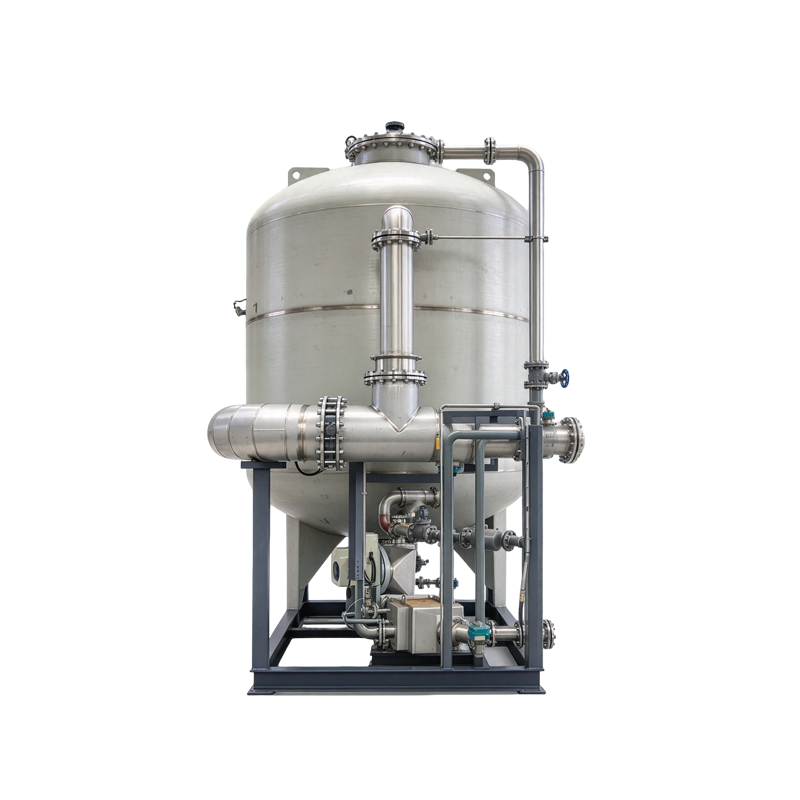
Resin tank
≥99.5%
Filtration efficiency
≤10 mg/m³
Outlet concentration
Equipment Introduction
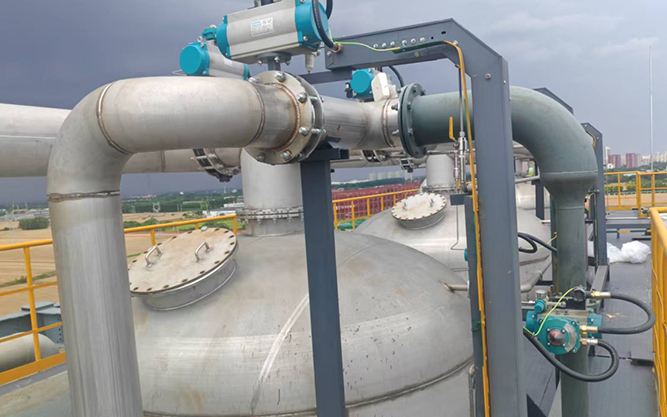
The resin vessel—constructed as a pressure vessel (or non-pressure vessel) from carbon steel, duplex stainless steel, or stainless steel—is filled with macroporous ion-exchange resin for the adsorption of gaseous media. In exhaust gas treatment applications, it is used for the adsorption and recovery of organic waste gases. The vessel is equipped with internal water/gas distribution components, as well as upper and lower Johnson-type screen pipes or screen plates, to ensure uniform distribution of the media.
Working Principle
Organic waste gas enters the vessel and passes through a bed of macroporous resin, where organic components are adsorbed and concentrated by the resin, while the purified gas is discharged. Once the macroporous resin reaches saturation, steam or hot nitrogen is introduced to desorb the organic solvents, which are then recovered via condensation. Following desorption, the resin is cooled with water, and the unit returns to the adsorption phase; by alternating between multiple vessels, the system achieves continuous operation.
Material Selection
The material for the resin vessel must be selected based on the specific composition of the exhaust gas and the operating conditions (e.g., acidic, alkaline, or corrosive environments):
Stainless steel (SUS304/316L): Suitable for high-temperature environments and conditions involving highly corrosive gases.
Duplex stainless steel (S32205): Suitable for high-temperature environments and conditions involving highly corrosive gases; it offers significantly superior resistance to acids and bases compared to 316L.
Carbon steel: A cost-effective option, suitable for standard operating conditions.
Notes on material selection:
For exhaust gases containing acidic components (e.g., SO₂): Duplex stainless steel or stainless steel resin vessels are recommended.
For exhaust gases containing alkaline components (e.g., NH₃): Duplex stainless steel or stainless steel resin vessels are recommended.
For exhaust gases containing chloride (Cl⁻) ions, the choice of material should be determined based on a comprehensive assessment of the specific operating conditions.
Application Areas
Organic solvent recovery is more effective for the treatment of chlorine-containing waste gases.
Product Advantages
Enclosed pressure vessel with uniform fluid distribution;
Supports automatic regeneration and continuous, cyclic operation;
Replaceable resin, adaptable to various separation objectives;
Vessel material options include carbon steel, 304 stainless steel, 316L stainless steel, and 2205 stainless steel.
|
model |
Airflow volume (m³/h) |
Tank diameter (mm) |
Tank height (mm) |
Work pressure |
Material |
|
RG‑500 |
1000 |
1000 |
2200 |
0.5MPa |
FRP/304SS |
|
RG‑1000 |
3000 |
1500 |
2600 |
0.5‑1.0MPa |
FRP/304/316L |
|
RG‑1500 |
5000 |
2000 |
3000 |
0.5‑1.0MPa |
304/316L |
Customization details: Vessel dimensions, pressure ratings, and internal screen assembly components are customized according to project requirements.
Related articles
Industrial Exhaust Gas Treatment Equipment
1793242405000
How Do Resin Vessels Facilitate Organic Solvent Recovery? An Explanation of the Adsorption and Desorption Process
Industrial Exhaust Gas Treatment Equipment
1793242382000
How to Choose the Material for Resin Tanks? Key Considerations for Acidic, Alkaline, and Chlorine-Containing Environments
Industrial Exhaust Gas Treatment Equipment
1793242360000
What parameters are required for selecting a resin tank? Information on model, pressure, and internal components
OEM
Customized for your process conditions
Get a tailored solution
FAQs
We could not find what you need. Please contact our team.
View details
How should the material for a resin tank be selected?
The selection of materials must take into account the presence of acidic, alkaline, or corrosive components in the exhaust gas, as well as factors such as temperature, pressure, and chloride ion concentration. Carbon steel is a cost-effective option suitable for standard operating conditions. Whether stainless steel or 2205 duplex stainless steel is appropriate depends on the specific medium and corrosive environment; a general label of "corrosion-resistant" is insufficient for making a final selection.
What are the materials and specifications for resin tanks?
The vessel can be constructed from carbon steel, 304 or 316L stainless steel, or 2205 duplex stainless steel; the internal screen assembly and vessel dimensions can be customized according to project requirements. The RG-500, RG-1000, and RG-1500 models listed have air handling capacities of 1,000, 3,000, and 5,000 m³/h, respectively. Operating pressures and material specifications vary by model; please refer to the finalized technical proposal for specific details.
Can the resin tank operate continuously?
Multiple vessels can be operated in an alternating sequence—integrating adsorption, desorption, and cooling stages—to meet the requirements for continuous operation. The number of vessels required and the switching cycle are determined based on the exhaust gas flow rate, the adsorption capacity of the resin, and the regeneration process.
How do resin tanks adsorb and recover organic solvents?
Organic waste gas enters the vessel and passes through a resin bed, where organic components are adsorbed by the macroporous resin, and the treated gas is then discharged. Once the resin becomes saturated, it can be regenerated (desorbed) by introducing steam or hot nitrogen; the desorbed solvents are subsequently recovered via condensation. Following desorption, the resin bed is cooled with water, and the vessel returns to the adsorption operating mode.
What are resin tanks primarily used for?
The resin vessel is packed with macroporous resin, designed for the adsorption of gaseous media. In exhaust gas treatment, it can be used for the adsorption and enrichment of organic waste gases, as well as for the recovery of organic solvents. Its specific applicability depends on the composition of the waste gas and the type of resin used.


Contact us
If you have questions or need help, contact our team for dedicated support.
We look forward to hearing from you
Submit
Online
Send email