







View details
Dust removal equipment
1793242660000
How Does a Pulse-Jet Bag Filter Work? An Explanation of the Filtration and Cleaning Process
Online


Send email


Product details
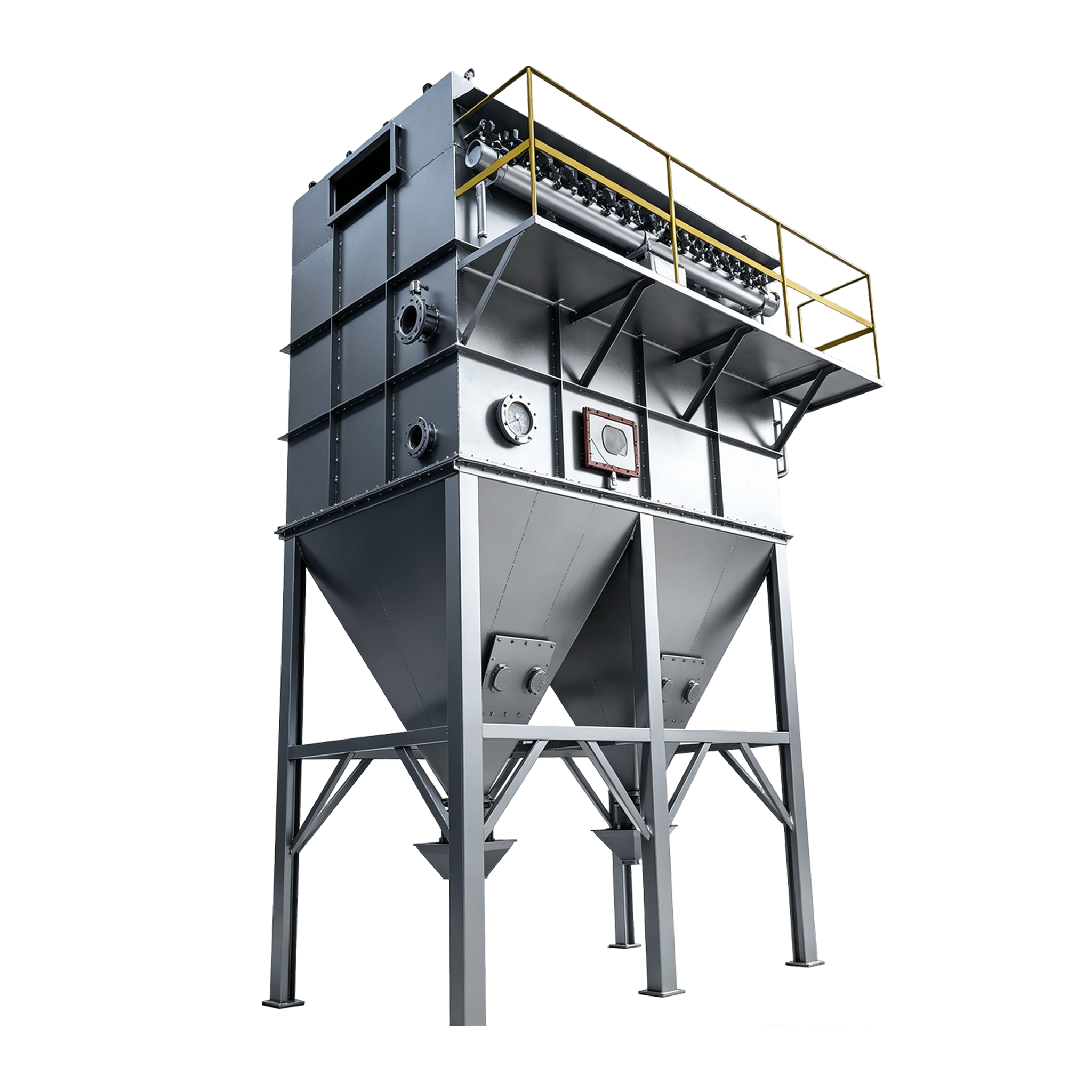
Baghouse dust collector
≥99.5%
Filtration efficiency
≤10 mg/m³
Outlet concentration
Equipment Introduction
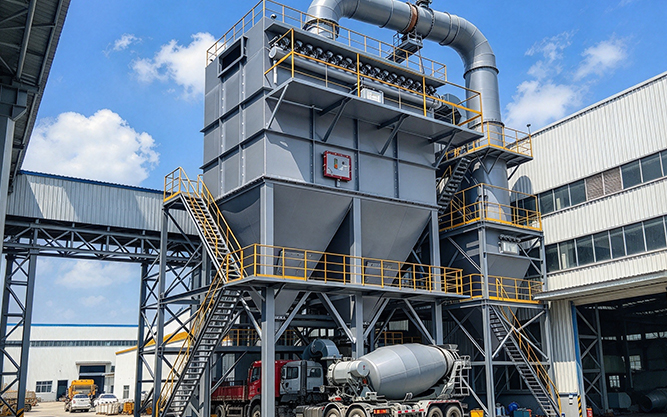
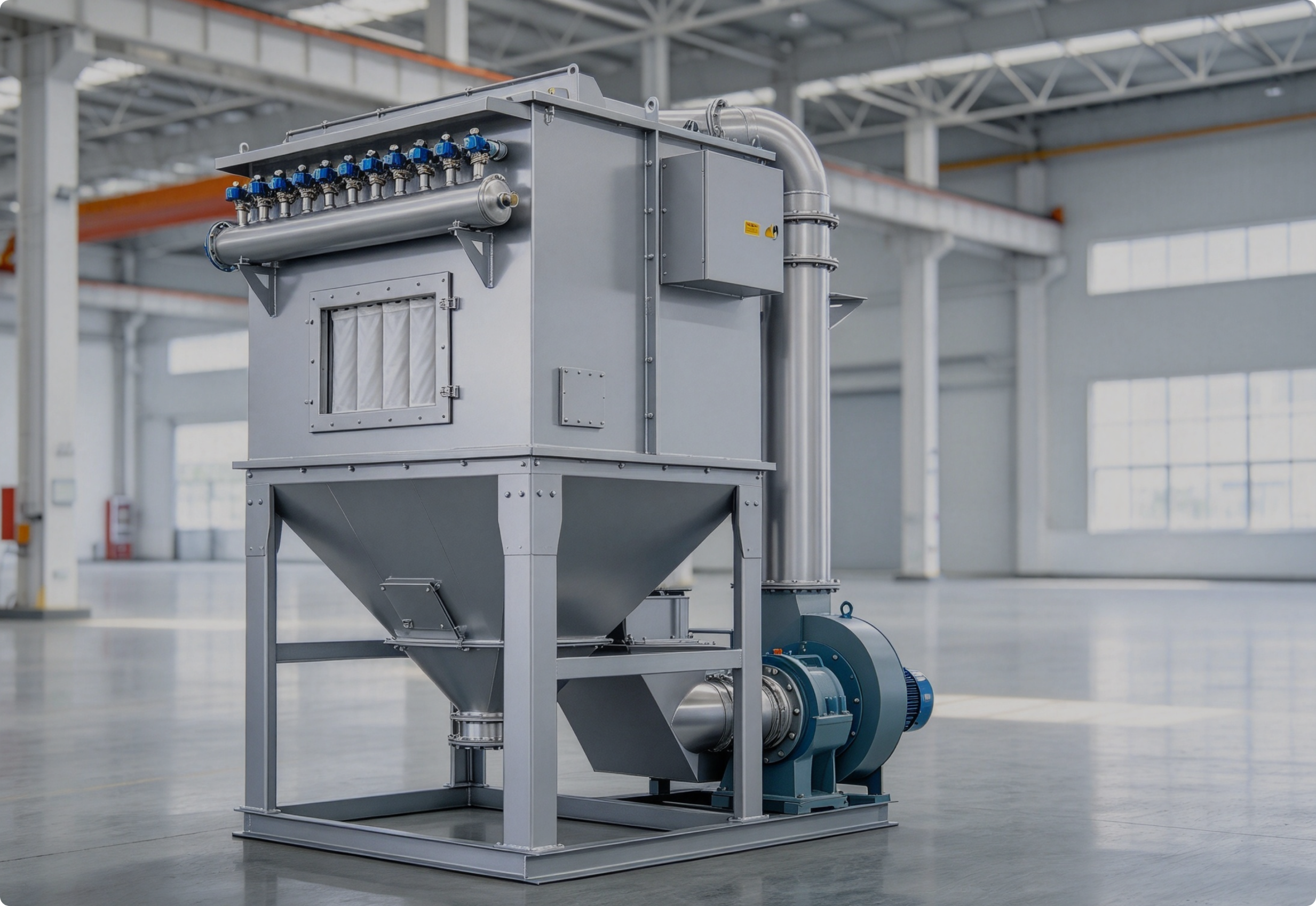
A baghouse dust collector is a highly efficient, dry-type filtration system that uses fabric filter bags to capture solid particulate matter from dust-laden gas. It employs pulse-jet cleaning technology to regenerate the filter bags, allowing for continuous, on-line operation. With a dust removal efficiency exceeding 99.5% and outlet emission concentrations as low as 10 mg/m³ or less, it serves as the primary equipment for industrial dust control and material recovery.
Working Principle
Dust-laden gas enters the middle chamber through the air inlet and is filtered as it passes over the exterior of the filter bags; dust particles are trapped on the outer surfaces of the bags, while the cleaned gas passes through the fabric into the upper chamber (clean-air plenum) and is discharged via the air outlet. As dust accumulates on the filter bags, the system's resistance increases. A pulse controller triggers electromagnetic pulse valves at set intervals, releasing compressed air (0.4–0.6 MPa) through nozzles on a blow-pipe into the filter bags. This causes the bags to expand instantaneously and generates a reverse airflow, dislodging the dust, which then falls into the hopper and is discharged through a rotary discharge valve (star valve) that maintains an airtight seal. The cleaning process is carried out compartment by compartment and row by row, ensuring that the equipment's normal operation remains uninterrupted.
Applicable Operating Conditions
• Industrial dust control: Woodworking, construction materials, metallurgy, mining, grain processing, friction materials, etc.
• Flue gas dedusting: Boilers, incinerators, industrial furnaces/kilns, asphalt mixing plants
• Powder recovery: Material recovery during processes such as conveying, packaging, screening, and feeding
• Flue gas temperature limits depend on the filter bag material (ambient temperature type ≤120°C; high-temperature type up to 260°C)
• System negative pressure: ≤5000 Pa
Applicable Operating Conditions for Different Materials
• For dry dust and standard ambient temperatures: Carbon steel is generally sufficient.
• For high-temperature, high-humidity, or highly corrosive dust (such as chemical dust): Stainless steel is recommended.
• For environments with explosive dust: Select materials that meet explosion-proof design requirements (e.g., aluminum alloy or stainless steel).
Application Areas
Exhaust gas dedusting and powder material recovery systems for industries such as cement plants, steel mills, thermal power plants, chemical plants, woodworking workshops, grain processing plants, waste incineration plants, asphalt mixing plants, non-ferrous metal smelting facilities, carbon plants, and refractory material plants.
Product Advantages
• High Dust Removal Efficiency: Filtration efficiency ≥99.5%, with an outlet concentration ≤10 mg/m³, meeting the most stringent emission standards.
• Online Cleaning: Employs pulse-jet, compartment-based cleaning, allowing for 24-hour continuous operation.
• Versatile Filter Media: Options include polyester, PPS, PTFE-laminated media, P84, and more, covering operating conditions from ambient to high temperatures.
• Robust Construction: Laser-cut tube sheets with a flatness tolerance ≤2‰; 60° conical hoppers designed to prevent material bridging, equipped with bin vibrators.
• Corrosion-Resistant and Durable: Finished with an epoxy zinc-rich primer and topcoat (total film thickness ≥120μm), ensuring an outdoor anti-corrosion lifespan of ≥5 years.
• Intelligent Control: Pulse controller supports both timed and pressure-differential-based cleaning modes, with a differential pressure gauge for real-time resistance monitoring.
Table of Common Models and Specifications
|
model |
Airflow volume to be handled |
Filtration area |
Cloth Bag Specifications |
Number of filter bags |
Equipment dimensions (length × width × height, mm) |
Number of pulse valves |
Plate thickness |
Common Materials |
|
DMC-60 |
3000 m³/h |
50~60 ㎡ |
Φ133×2000mm |
60 items |
1200×1200×3500 |
6 animals |
Casing 3.0 mm, tube sheet 4 mm |
Powder-coated Q235 carbon steel |
|
DMC-100 |
5000 m³/h |
80~100 ㎡ |
Φ133×2000/2500mm |
100 items |
1500×1500×3800 |
10 animals |
Casing 3.0 mm, tube sheet 4 mm |
Powder-coated Q235 carbon steel |
|
DMC-128 |
8000 m³/h |
130~150 ㎡ |
Φ133×2500mm |
128 items |
1800×1800×4200 |
12~15 animals |
Casing 3.0 mm, tube sheet 4 mm |
Powder-coated Q235 carbon steel |
|
DMC-180 |
10000 m³/h |
160~180 ㎡ |
Φ133×2500mm |
180 items |
2000×2000×4500 |
18 animals |
Casing 3.0 mm, tube sheet 4 mm |
Powder-coated Q235 carbon steel |
|
DMC-360 |
20000 m³/h |
300~350 ㎡ |
Φ133×2500/3000mm |
360 items |
3000×2500×5200 |
30~36 animals |
Casing 3.0 mm, tube sheet 4 mm |
Q235 carbon steel with powder coating or baked-on paint finish; 304 stainless steel also available as an option. |
Customization details: Airflow capacity, dimensions, enclosure material, and accessories can all be tailored to the customer’s specific operating conditions; OEM services are available.
Key Technical Parameters
|
Parameter Item |
index |
|
Filtration air velocity |
0.6~1.5 m/min |
|
Dust removal efficiency |
≥99.5% |
|
Outlet concentration |
≤10 mg/m³ |
|
Equipment resistance |
1200~1800 Pa |
|
Compressive strength |
-5000 Pa |
|
Air leakage rate |
≤2% |
|
Dust removal method |
Pulse-jet cleaning (selectable: timed or pressure-drop-based) |
|
Compressed air pressure |
0.4~0.6 MPa |
Related articles
Dust removal equipment
1793242660000
How Does a Pulse-Jet Bag Filter Work? An Explanation of the Filtration and Cleaning Process
Dust removal equipment
1793242637000
How to Select a Baghouse Dust Collector? An Explanation of Airflow, Filtration Area, and Model Parameters
Baghouse dust collector
1793242613000
How to Choose Filter Bags for Baghouse Dust Collectors? A Guide to Temperature, Dust Characteristics, and Operating Conditions
OEM
Customized for your process conditions
Get a tailored solution
FAQs
We could not find what you need. Please contact our team.
View details
How should one select a model for a bag filter?
When selecting equipment, it is necessary to first determine the air volume to be handled, the characteristics of the dust, the flue gas temperature, and the target emission requirements. Subsequently, verify the filtration area, filtration velocity, specifications and quantity of filter bags, the dust-cleaning configuration, and the equipment's pressure drop. Other dimensions, materials, and accessories can be customized according to specific operating conditions.
What are the dust removal efficiency and outlet concentration of a bag filter?
The dust removal efficiency is ≥99.5%, and the outlet concentration is ≤10 mg/m³. Actual results may be influenced by factors such as the properties of the dust, the material of the filter bags, the filtration velocity, the sealing of the equipment, and the operating conditions; specific performance metrics should be determined based on project design specifications and test results.
What is the maximum flue gas temperature that a fabric filter (baghouse) can handle?
The applicable temperature range depends on the material of the filter bag. Standard-temperature filter bags are generally rated for temperatures up to 120°C, while high-temperature versions can withstand up to 260°C. The specific filter medium and its upper temperature limit should be determined by considering the flue gas temperature, humidity, and the characteristics of the dust.
How does a pulse-jet bag filter work?
As dust-laden gas enters the middle chamber, dust particles are trapped on the outer surfaces of the filter bags. The cleaned gas passes through the filter bags into the clean-air chamber and is then discharged. As dust accumulates on the filter bags and the equipment's resistance increases, the pulse control system triggers the solenoid pulse valves; compressed air is then injected into the filter bags, dislodging the accumulated dust, which falls into the hopper and is subsequently removed by the dust discharge mechanism.
What are baghouse dust collectors primarily used for?
Baghouse dust collectors capture solid particles from dust-laden gas streams using filter bags; they are suitable for industrial dust control and the recovery of powdered materials. Common applications include woodworking, construction materials, metallurgy, mining, grain processing, boiler flue gas treatment, as well as processes such as material conveying, packaging, screening, and feeding.


Contact us
If you have questions or need help, contact our team for dedicated support.
We look forward to hearing from you
Submit
Online
Send email