







View details
Industrial Exhaust Gas Treatment Equipment
1793241301000
How to Choose Between PP, FRP, and Stainless Steel Spray Towers? A Comparison of Materials and Operating Conditions
Online


Send email


Product details
Spray Tower
≥99.5%
Filtration efficiency
≤10 mg/m³
Outlet concentration
Equipment Introduction
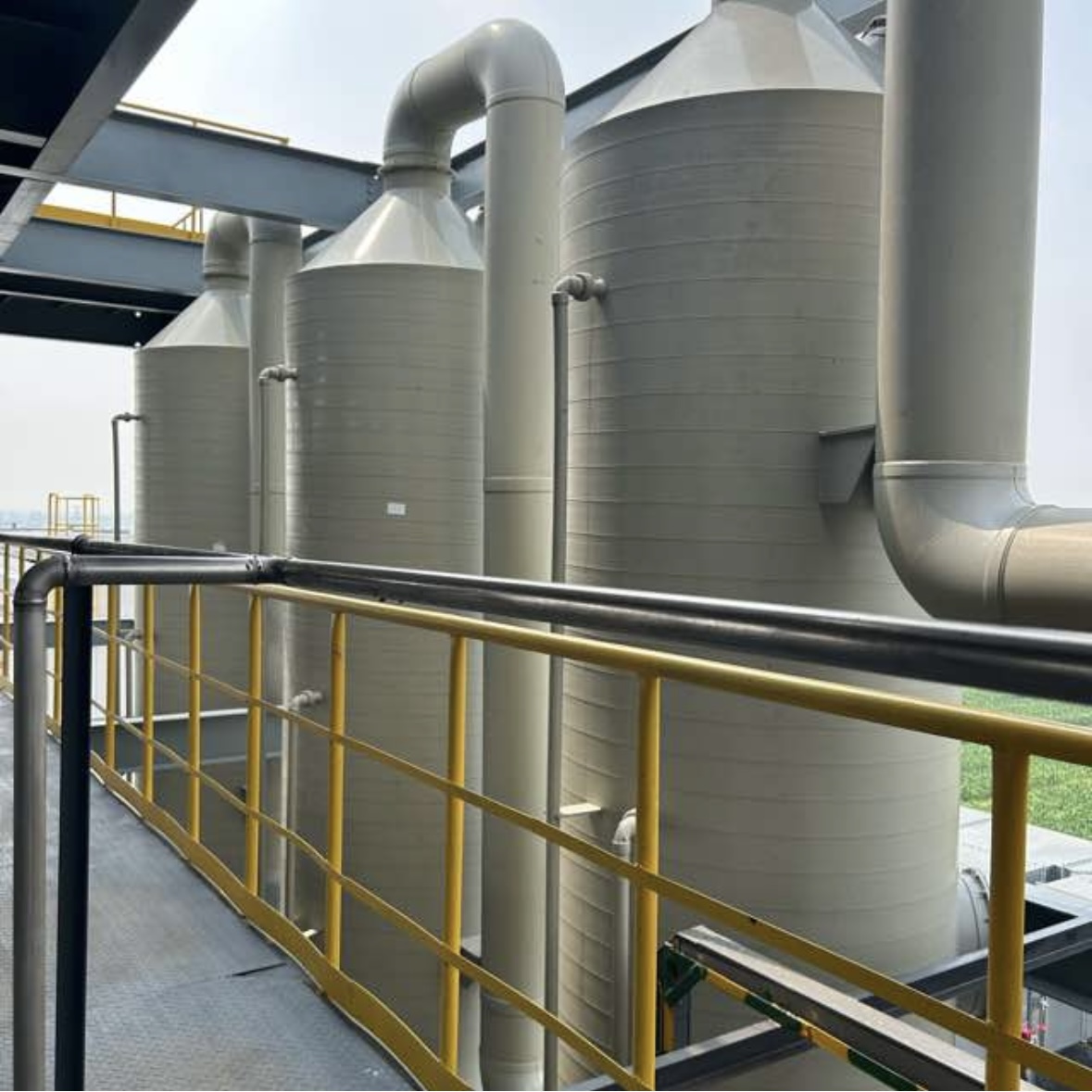
A spray tower is a highly efficient wet-type exhaust gas purification device. By facilitating thorough countercurrent contact between a spray liquid and the exhaust gas within the tower, it employs chemical processes—such as absorption, neutralization, and redox reactions—to remove acidic or alkaline gases, water-soluble pollutants, and particulate matter. It is one of the most widely used primary treatment devices in industrial exhaust gas management.
Working Principle
Exhaust gas enters the tower tangentially through an inlet at the lower section and flows upward. A circulating pump delivers the absorption liquid (water or a chemical agent) to the top of the tower, where it is atomized by spiral spray nozzles and distributed downward. Within the packed bed section, the liquid forms a uniform film over the surface of the packing material, ensuring thorough contact with the rising gas stream, whereby pollutants in the exhaust gas are captured by the absorption liquid. The purified gas passes through a baffle-type mist eliminator at the top of the tower to remove entrained droplets before being discharged in compliance with emission standards. The absorption liquid collects in a reservoir at the base of the tower, where it is treated with chemical additives and recirculated.
Applicable Operating Conditions
• Treatment of acidic/alkaline exhaust gases: HCl, HF, NH₃, H₂SO₄ acid mist, NOx, etc.
• Pre-treatment and cooling of dust-laden exhaust gases
• Pre-treatment of water-soluble VOCs at moderate concentrations
• Exhaust gas temperature limits: ≤80°C for PP, ≤120°C for FRP (fiber-reinforced plastic), and ≤300°C for stainless steel
• Airflow treatment capacity: 500–100,000 m³/h
Application Areas
Widely used in exhaust gas purification systems across industries such as chemical manufacturing, electronics, electroplating, pharmaceuticals, printing, coating, metallurgy, food processing, and laboratory ventilation; often employed in combination with equipment such as activated carbon adsorption units, UV-photocatalytic oxidation systems, or regenerative thermal oxidizers (RTO).
Product Advantages
• High purification efficiency: ≥95% for acid/alkali exhaust gases; ≥99% for mist elimination (for droplets >10μm).
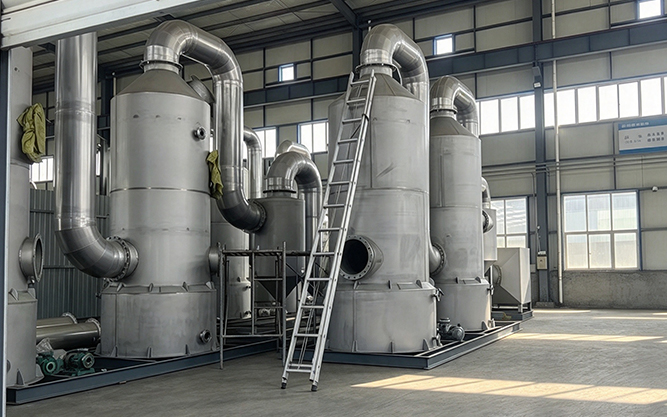
• Versatile material options: Available in PP (polypropylene), FRP (fiber-reinforced plastic), and 304/316L stainless steel, covering a full range of operating conditions—from ambient to high temperatures, and from mild to highly corrosive environments.
• Compact design: Vertical counter-current configuration with an empty-tower gas velocity of 1.2–1.8 m/s and a gas-liquid contact time of ≥2 seconds.
• Stable operation: Equipped with an online pH monitoring system, automatic chemical dosing, and automated regulation of circulating water flow.
• Easy maintenance: Features access manholes; packing media and spray nozzles can be replaced quickly.
Table of Common Models and Specifications
|
model |
Airflow volume to be handled |
Tower diameter |
Total tower height |
PP sheet thickness |
FRP panel thickness |
Thickness of 304 stainless steel plate |
Number of spray layers |
|
PLT-3000 |
3000 m³/h |
φ1000 mm |
6000 mm |
8~10 mm |
8~10 mm |
1.5~2.0 mm |
2–3 floors |
|
PLT-5000 |
5000 m³/h |
φ1300 mm |
6500 mm |
10 mm |
8~10 mm |
2.0 mm |
2–3 floors |
|
PLT-8000 |
8000 m³/h |
φ1700 mm |
6500 mm |
10~12 mm |
8~10 mm |
2.0 mm |
2–3 floors |
|
PLT-10000 |
10000 m³/h |
φ2000 mm |
6500 mm |
12 mm |
8~10 mm |
2.0~2.5 mm |
2–3 floors |
|
PLT-20000 |
20000 m³/h |
φ2500 mm |
7000 mm |
12~15 mm |
8~10 mm |
2.5~3.0 mm |
floor 3 |
Material Selection Comparison Table
|
Material |
Applicable Operating Conditions |
Upper temperature limit |
Tower wall thickness |
Service life |
Features Description |
|
304Stainless steel |
High-temperature/oil-laden exhaust gas |
≤300℃ |
3~5 mm |
More than 15 years |
High-temperature resistant, high strength, easy to clean |
|
316LStainless steel |
Highly corrosive/high temperature |
≤300℃ |
3~5 mm |
More than 15 years |
Resistant to chloride ion corrosion; suitable for highly corrosive environments in the chemical industry. |
|
PPPolypropylene |
Acidic/alkaline exhaust gas, ambient temperature |
≤80℃ |
10~12 mm |
8–10 years |
Most commonly used, cost-effective, and offers good corrosion resistance. |
|
FRPFiberglass-reinforced plastic (FRP) |
Acidic/alkaline exhaust gas, medium temperature |
≤120℃ |
8~12 mm |
10–15 years |
High strength, good formability, and resistance to moderate temperatures |
Key technical parameters: superficial gas velocity 1.2–1.8 m/s; gas residence time ≥2 s; packing height 400–1500 mm (using φ50 mm multi-faceted hollow spheres); equipment pressure drop 500–800 Pa; air leakage rate ≤2%.
Related articles
Industrial Exhaust Gas Treatment Equipment
1793241301000
How to Choose Between PP, FRP, and Stainless Steel Spray Towers? A Comparison of Materials and Operating Conditions
Industrial Exhaust Gas Treatment Equipment
1793241282000
What parameters are required for selecting a spray tower? How is the treatment air volume determined?
Industrial Exhaust Gas Treatment Equipment
1793241248000
How can a spray tower be combined with an activated carbon adsorption unit, a UV photolysis/oxidation system, or an RTO (Regenerative Thermal Oxidizer)?
OEM
Customized for your process conditions
Get a tailored solution
FAQs
We could not find what you need. Please contact our team.
View details
How should a spray tower be maintained?
Equipment maintenance involves the inspection and replacement of components such as access manholes, packing, and spray nozzles. The management of circulating fluid, chemical dosing, and cleaning intervals should be determined based on the specific exhaust gas conditions and the operational status of the equipment.
What is the purification efficiency of a spray tower?
The reference values provided in the product documentation indicate an efficiency of ≥95% for the purification of acidic/alkaline exhaust gases, and an efficiency of ≥99% for the removal of liquid droplets larger than 10 μm. Actual performance may vary depending on the specific pollutants, absorption liquid, operating parameters, and testing conditions; therefore, project-specific design specifications and test results should be taken as the definitive criteria.
What is the treatment air volume range for a spray tower?
The product documentation specifies an operating air volume range of 500–100,000 m³/h. The specific model should be selected based on the required air volume, the composition and temperature of the exhaust gas, and the specific treatment requirements.
What materials are available for spray towers, and what is their temperature range?
Available material options include PP, FRP (fiber-reinforced plastic), and 304/316L stainless steel. Reference temperature ranges are as follows: PP ≤ 80°C, FRP ≤ 120°C, and stainless steel ≤ 300°C. The actual upper operating limit must be determined based on the specific medium, its corrosivity, and the equipment design.
Can a spray tower handle VOCs?
Spray towers can be used for the pretreatment of certain water-soluble VOCs; however, this does not imply that they are capable of treating all types of VOCs on their own. The actual effectiveness must be evaluated based on the specific types and concentrations of the VOCs, as well as the subsequent treatment processes.
What types of acidic or alkaline gases can a spray tower handle?
The substances listed as applicable include HCl, HF, NH₃, H₂SO₄ acid mist, and NOx. As different gases require different absorption liquids and operating conditions, the design scheme should be determined based on the actual composition of the waste gas.
What is the working principle of a spray tower?
Exhaust gas enters the lower part of the tower and flows upward, while the absorbing liquid is sprayed from the top and flows downward. As the gas and liquid come into contact within the packed section, pollutants are captured by the absorbing liquid; the purified gas then passes through a mist eliminator to remove any entrained droplets.
What kind of waste gas are spray towers primarily used to treat?
Spray towers are primarily used for treating acidic or alkaline gases, water-soluble pollutants, and for the pre-treatment of certain dust-laden exhaust streams. Their suitability for specific pollutants must be determined by considering the composition and concentration of the exhaust gas, as well as the choice of absorption liquid.


Contact us
If you have questions or need help, contact our team for dedicated support.
We look forward to hearing from you
Submit
Online
Send email