







View details
Dust removal equipment
1793242720000
How Does a Pulse-Jet Cartridge Dust Collector Work? An Explanation of the Filtration and Automatic Cleaning Process
Online


Send email


Product details
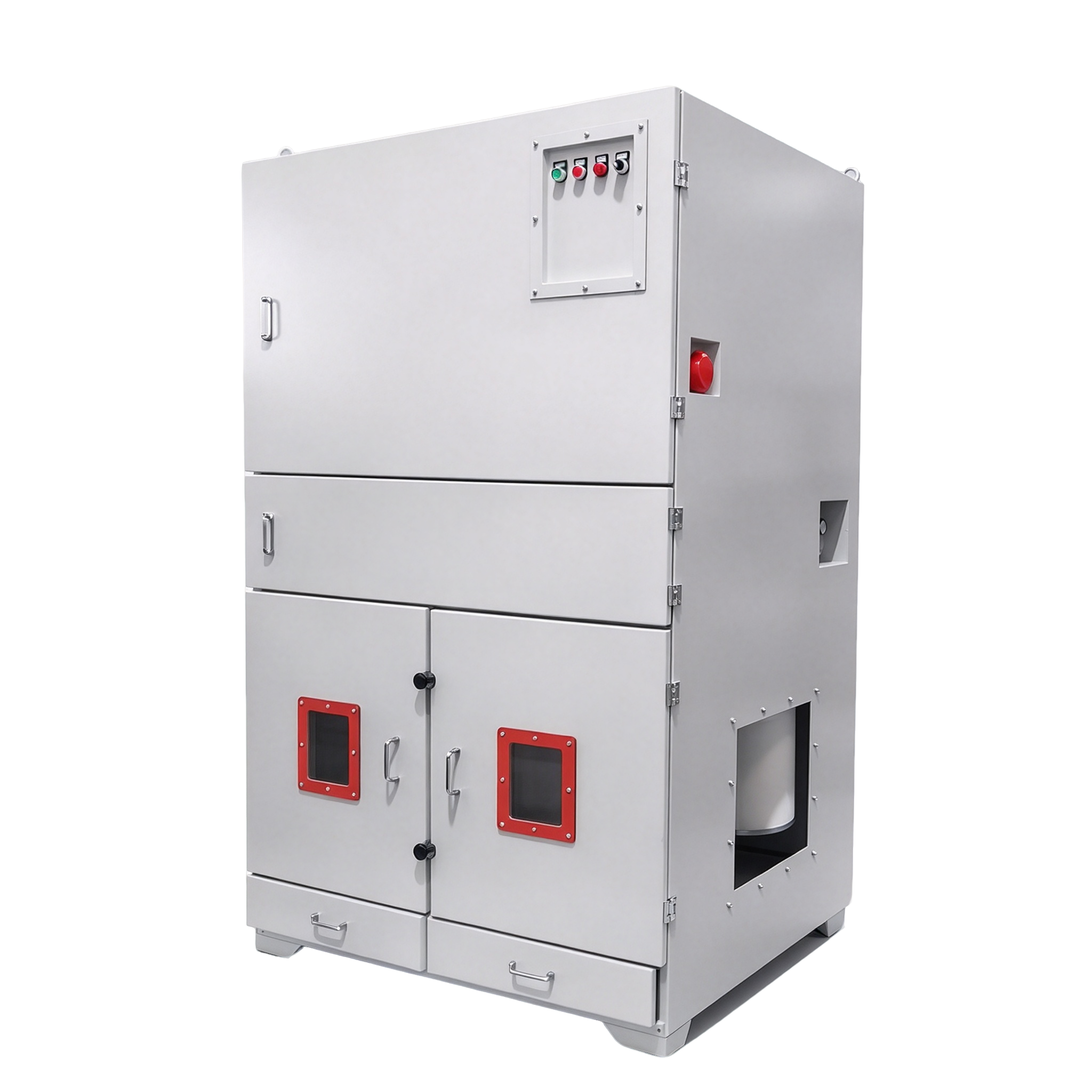
Pulse-jet cartridge dust collector
≥99.5%
Filtration efficiency
≤10 mg/m³
Outlet concentration
Product Definition
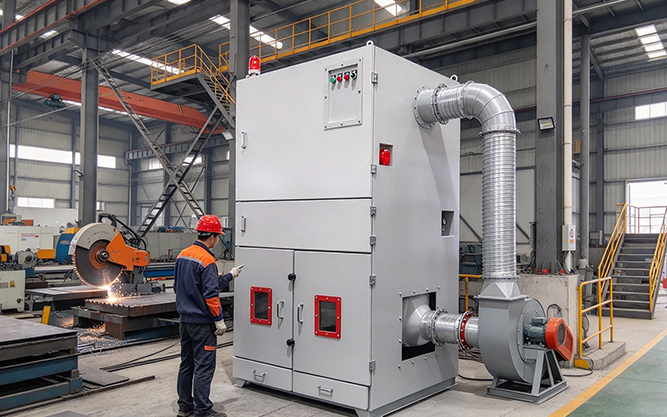
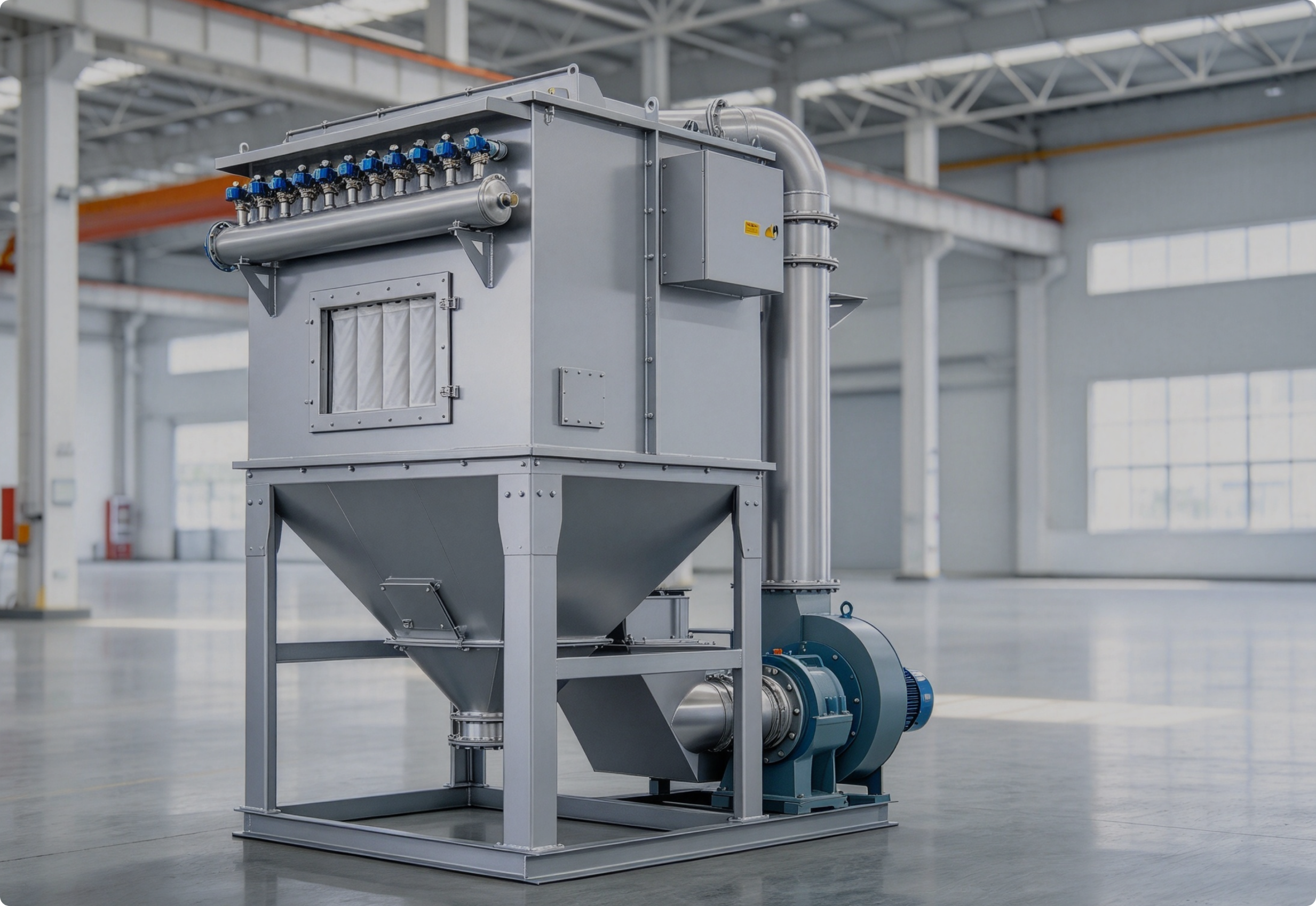
The pulse-jet cartridge dust collector is a compact, high-efficiency industrial dust removal system. Utilizing advanced pleated, high-precision filter cartridge technology, it offers a more space-efficient design and superior filtration accuracy compared to traditional bag-house dust collectors. The unit integrates dust collection, airflow filtration, automatic pulse-jet cleaning, and clean-air exhaust. Specifically engineered for fine, dry industrial dust, welding fumes, and airborne particulate matter, it features a small footprint, high purification efficiency, stable operation, and ease of maintenance. It serves as a core environmental protection solution for industrial dust control, workshop air purification, and exhaust gas pre-treatment, and complies with international environmental standards such as CE and ISO.
Working Principle
The equipment operates under a negative-pressure suction mode. Dust-laden air enters the unit through an inlet and is buffered and distributed by an internal airflow equalization plate; larger dust particles settle directly into the bottom hopper due to gravity. Finer, suspended dust particles are carried by the airflow into the filtration zone, where they are captured and adsorbed by the high-precision filter media. Once the air has passed through the filter cartridges, it is discharged by a fan (driven by negative pressure). The system is equipped with an automatic pulse-jet cleaning mechanism that periodically delivers high-pressure air bursts to dislodge dust accumulated on the surface of the filter cartridges, causing it to fall into the hopper. This ensures the filter cartridges remain permeable and maintains consistent dust-removal efficiency, allowing for 24-hour, fully automated, continuous, and unattended operation.
Applicable Operating Conditions
• Processed Media: Dry, fine dust—including welding fumes, grinding dust, laser-cutting dust, plastic dust, and airborne particles generated during powder handling/feeding.
• Operating Conditions: Suitable for dry, ambient-temperature environments with low humidity. Anti-static and explosion-proof configurations are available for applications involving flammable or explosive dust.
• Filtration Precision: Capable of effectively capturing fine suspended particles as small as 0.3 μm, meeting high-precision dust removal and purification requirements.
• Typical Applications: Dust extraction for individual workstations, localized dust collection on production lines, facility-wide dust control, and pre-treatment of exhaust air from dust-generating processes.
Material Selection
• For dry dust and standard ambient temperatures: Carbon steel is generally sufficient.
• For high-temperature, high-humidity, or highly corrosive dust (such as chemical dust): Stainless steel is recommended.
• For environments with explosive dust: Select materials that meet explosion-proof design requirements (e.g., aluminum alloy or stainless steel).
Industry Applications
This equipment is widely used across various sectors, including machining, hardware grinding, laser cutting, welding and fabrication, plastics and chemicals, construction materials and ceramics, food and pharmaceuticals, electronics manufacturing, new energy, and mining and metallurgy. It is primarily employed for dust extraction at grinding stations, purification of welding fumes, management of dust generated during cutting processes, dust control during powder feeding, and comprehensive dust management throughout the workshop. These solutions effectively reduce dust concentrations, improve the working environment, and ensure both operational safety and compliance with environmental regulations.
Product Advantages
Ultra-high purification precision: Achieves ≥99.9% filtration efficiency for 0.3μm fine dust, ensuring high exhaust cleanliness that fully complies with domestic and international environmental emission standards.
Compact design with a small footprint: Utilizes pleated filter cartridges to significantly increase filtration surface area; the unit’s volume is only two-thirds that of traditional bag-type dust collectors, making it ideal for installation in confined workshops or compact workstations.
Fully automated intelligent operation: Features an intelligent pulse-jet cleaning system that operates automatically, eliminating the need for frequent manual intervention and substantially reducing labor costs for operation and maintenance.
Versatile application: Offers a wide range of filter media options, with customizable configurations—including high-temperature resistant, anti-static, and explosion-proof models—to suit diverse and complex dust-handling environments.
Low noise and energy efficiency: Engineered with an optimized airflow design, the unit operates at ≤80dB; the low-energy-consumption fan ensures energy efficiency and environmental compliance during long-term operation.
Simple and rapid maintenance: Designed with a side-access maintenance structure, allowing for quick removal and replacement of filter cartridges; this minimizes downtime and ensures production schedules remain unaffected.
Quality compliance for seamless export: The equipment meets CE and ISO9001 quality management standards, ensuring consistent quality that facilitates successful project acceptance and export trade.
Table of Common Models and Specifications
|
model |
Airflow capacity (m³/h) |
Filtration area (m²) |
Filter Cartridge Specifications |
Number of filter cartridges |
Device dimensions (length × width × height, mm) |
Number of pulse valves |
Plate thickness configuration |
Common Materials |
|
LCC 6 |
3000 |
50 70 |
Φ325×660mm |
6 single |
1200×1100×2800 |
3 single |
Casing 3.0 mm, tube sheet 4 mm |
Q235 carbon steel (powder-coated) / 304 stainless steel |
|
LCC 12 |
5000 |
85 100 |
Φ325×660mm |
12 single |
1500×1200×3000 |
4 single |
Casing 3.0 mm, tube sheet 4 mm |
Q235 carbon steel (powder-coated) / 304 stainless steel |
|
LCC 16 |
8000 |
130 150 |
Φ325×660mm |
16 single |
1700×1400×3100 |
6 single |
Casing 3.0 mm, tube sheet 4 mm |
Q235 carbon steel (powder-coated) / 304 stainless steel |
|
LCC 24 |
10000 |
170 195 |
Φ325×660mm |
24 single |
1900×1600×3300 |
8 single |
Casing 3.0 mm, tube sheet 4 mm |
Q235 carbon steel (powder-coated) / 304 stainless steel |
|
LCC 32 |
15000 |
240 270 |
Φ325×660mm |
32 single |
2200×1800×3400 |
12 single |
Casing 3.0 mm, tube sheet 4 mm |
Q235 carbon steel (powder-coated) / 304 stainless steel |
Customization details: Airflow capacity, dimensions, enclosure material, and accessories can all be tailored to the customer’s specific operating conditions; OEM services are available.
Key Technical Parameters
|
Parameter Item |
index |
|
Filtration air velocity |
0.8 1.2 m/min |
|
Dust removal efficiency |
≥99.9% |
|
Outlet emission concentration |
≤10 mg/m³ |
|
Equipment resistance |
1000 1600 Pa |
|
Compressive strength |
-5000 Pa |
|
Air leakage rate |
≤2% |
|
Dust removal method |
Pulse-jet cleaning (selectable: timed / resistance-based) |
|
Compressed air pressure |
0.4 0.6 MPa |
Related articles
Dust removal equipment
1793242720000
How Does a Pulse-Jet Cartridge Dust Collector Work? An Explanation of the Filtration and Automatic Cleaning Process
Dust removal equipment
1793242702000
For which processes are cartridge dust collectors suitable? An overview of dust types and application scenarios
Dust removal equipment
1793242686000
How to Select a Pulse-Jet Cartridge Dust Collector? An Explanation of Airflow, Filtration Area, and Operating Parameters
OEM
Customized for your process conditions
Get a tailored solution
FAQs
We could not find what you need. Please contact our team.
View details
What models of cartridge dust collectors are available, and which parameters should be considered when selecting one?
Typical operating air volumes range from 3,000 to 15,000 m³/h, with filtration areas between 50 and 270 m² and 6 to 32 filter cartridges. Equipment selection should also account for factors such as dust type, air volume, filtration velocity, available installation space, the dust-cleaning mechanism, and compressed air specifications; the final equipment configuration must be calculated based on the specific operating conditions of the project.
For what temperature and humidity conditions are cartridge dust collectors suitable?
Primarily intended for applications involving dust under ambient temperature, dry, and low-humidity conditions. If the dust is at a high temperature, has high humidity, or is corrosive, it is necessary to evaluate the suitability of the filter media and equipment materials; the specific temperature range should be determined based on the filter media and the operating conditions.
How fine a dust particle can a cartridge dust collector filter out? What is its dust removal efficiency?
The equipment is capable of capturing particles 0.3 μm and larger, with a design performance of ≥99.9% dust removal efficiency and an outlet concentration of ≤10 mg/m³. Actual performance may be influenced by factors such as the nature of the dust, the filter media used, the filtration velocity, equipment sealing, and operating conditions; specific performance metrics should be determined based on project design specifications and test results.
How do pulse-jet cartridge dust collectors perform filtration and dust cleaning?
Once the dust-laden gas enters the equipment, large dust particles settle into the hopper, while finer dust is captured by the filter media of the filter cartridges. As dust accumulates on the cartridges, a pulse system—triggered either at set intervals or based on resistance thresholds—discharges compressed air, dislodging the collected dust so that it falls into the hopper.
What types of dust are primarily handled by pulse-jet cartridge dust collectors?
Suitable for applications involving dry, fine dust, welding fumes, grinding dust, laser-cutting dust, plastic dust, and airborne particles generated during the feeding of powdered materials. Actual suitability should be determined based on specific dust characteristics, temperature, humidity, and the production process.


Contact us
If you have questions or need help, contact our team for dedicated support.
We look forward to hearing from you
Submit
Online
Send email