







View details
Wedge wire screen
1793243323000
How Do Wedge Wire Screen Panels Work? An Overview of Their Structure and Applications in Screening and Filtration
Online


Send email


Product details
Sieve plate
≥99.5%
Filtration efficiency
≤10 mg/m³
Outlet concentration
Equipment Introduction
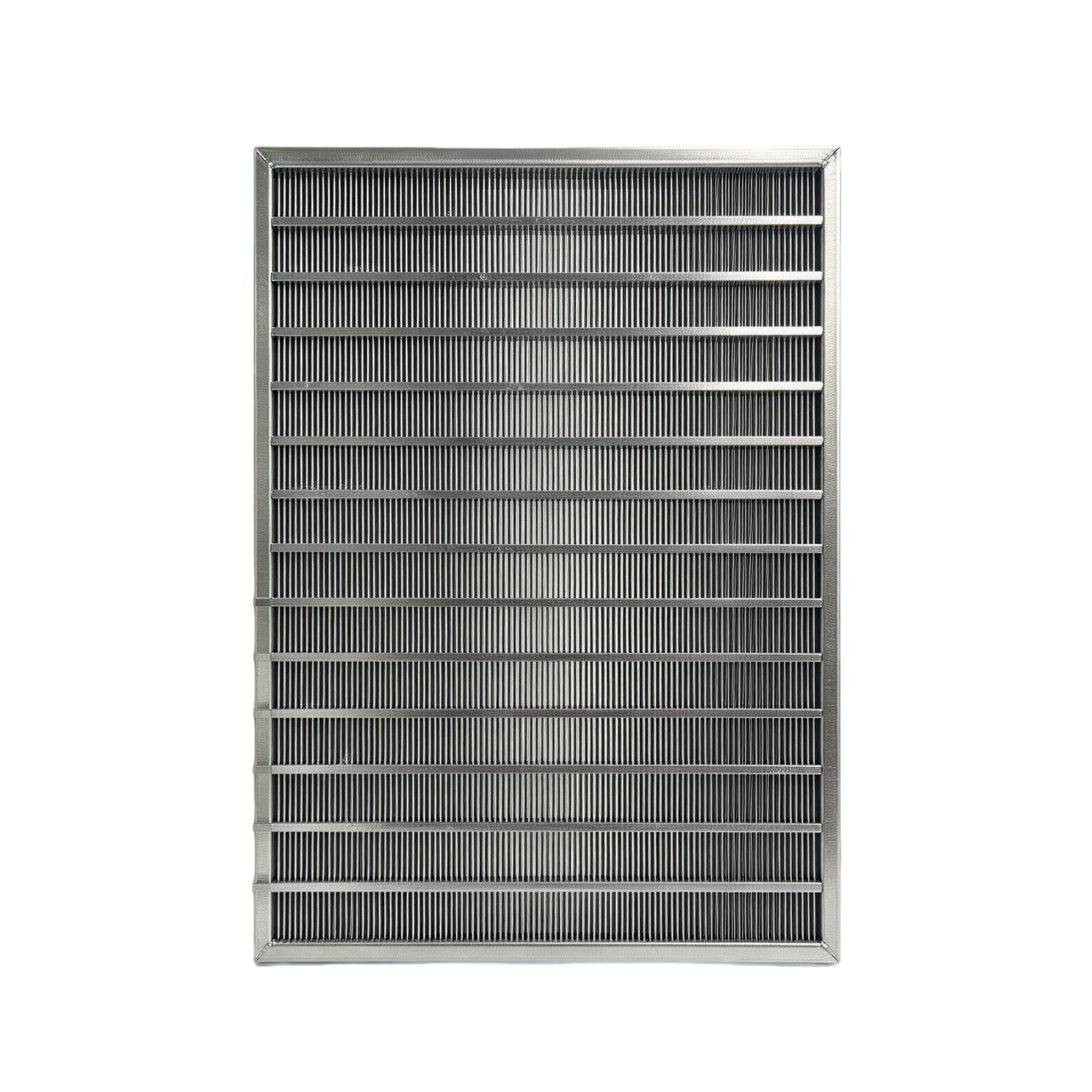
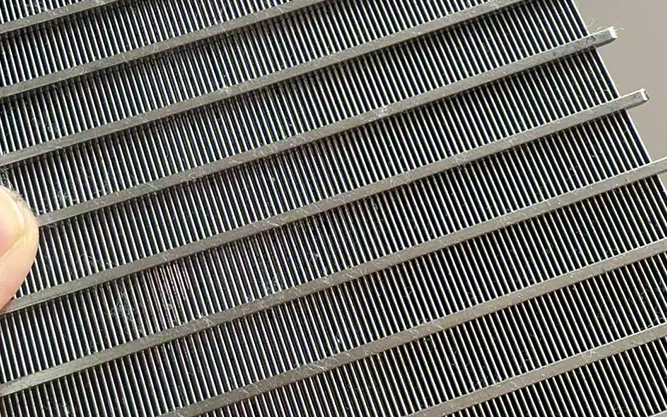
Wedge-wire screen panels are constructed by arranging V-shaped profile wires transversely and welding them onto longitudinal support rods, forming a flat (or alternatively, curved or bent) screening and filtration component. These panels are primarily used for applications such as planar water or gas distribution, material dewatering, solid-liquid separation, packing support, base plates for filtration equipment, and curved screens. They are typically employed for flat-surface filtration and screening within tanks or vessels, distinguishing them from cylindrical wedge-wire screen tubes.
Structural Features
Flat Design: Constructed by welding wedge-shaped wires (V-shaped wires) to support rods, resulting in a flat configuration.
The screen plate features uniform slots (known as "wedge-shaped slots") with precise widths that can be customized to meet specific process requirements.
Available in various forms, including flat panels, curved panels, or integrated designs.
Primary Uses
Screen plates are typically used for surface filtration and separation tasks; they are very common in applications that require a large filtration area or involve screening operations.
Applicable Scenarios and Industries
Mining: Used for the dewatering, classification, and screening of coal, sand, gravel, and ores—for instance, as screen panels on linear or circular vibrating screens.
Water Treatment: Employed in applications such as gravity (arc) screens in wastewater treatment plants or as static screen panels in water treatment equipment.
Chemical and Petrochemical: Utilized for solution degassing and as filtration elements in catalyst separation equipment.
Food Industry: Applied in solid-liquid separation during the processing of food fluids, such as filter screens for juice extractors or syrup filtration.
Pharmaceutical Industry: Used for the filtration and purification of pharmaceutical liquids.
Common Materials
Since wedge-wire screen panels are primarily used in demanding environments, they are typically fabricated from materials that offer resistance to corrosion, high temperatures, and pressure:
Stainless steel series: 304, 304L, 316, and 316L (the most common choices; they provide excellent corrosion and wear resistance, making them suitable for applications such as water treatment and food and beverage processing).
Duplex stainless steel: Used in environments requiring superior corrosion resistance, such as seawater filtration.
Special alloys: Such as Hastelloy or Inconel, used in high-temperature and highly corrosive environments.
Carbon steel: A cost-effective option for applications with low corrosion risk; requires surface anti-corrosion treatment.
advantage
Precise slot design (ranging from 20 microns to several millimeters) ensures consistent filtration performance.
Highly resistant to wear and corrosion, offering a long service life.
Easy to clean, with a reduced risk of clogging.
Can be customized into curved, flat, or specially shaped screens to meet specific requirements.
Common types
Flat Screen Plate: Suitable for linear filtration applications.
Curved Screen Plate: Suitable for gravity-based solids discharge and dewatering operations.
Table of Standard Specifications
|
model |
Dimensions (length × width mm) |
Gap mm |
Perforation rate |
Total thickness of the panel mm |
Common Materials |
|
JW PL 600×300 |
600×300 |
0.05 2.0 |
10% 30% |
10 25 |
SS304/SS316L |
|
JW PL 1000×500 |
1000×500 |
0.1 3.0 |
12% 35% |
12 30 |
SS304/SS316L |
|
JW PL 1500×800 |
1500×800 |
0.2 5.0 |
15% 40% |
15 35 |
SS304/SS316L / Duplex steel |
|
JW PL 2000×1000 |
2000×1000 |
0.3 8.0 |
18% 45% |
20 40 |
SS304 / Rubber-lined carbon steel |
|
JW PL 2500×1200 |
2500×1200 |
0.5 10.0 |
20% 50% |
25 50 |
SS304 / Rubber-lined carbon steel |
Related articles
Wedge wire screen
1793243323000
How Do Wedge Wire Screen Panels Work? An Overview of Their Structure and Applications in Screening and Filtration
Wedge wire screen
1793243301000
How to Select Slot Size and Open Area for Wedge Wire Screen Panels? Considerations for Dimensions and Structural Design
Wedge wire screen
1793243279000
How to Choose the Material for Wedge Wire Screen Panels? Applicability of Stainless Steel, Duplex Steel, and Carbon Steel
OEM
Customized for your process conditions
Get a tailored solution
FAQs
We could not find what you need. Please contact our team.
View details
What structural configurations and dimensions can be customized for wedge-wire screen panels?
Screen plates can be customized to meet specific equipment requirements—whether flat, curved, bent, or in a composite configuration—with tailored dimensions, gap sizes, aperture ratios, thicknesses, and materials. Providing equipment drawings, installation space details, the medium being processed, and specific screening requirements will help determine the precise specifications for the screen plates.
What materials are available for wedge-wire screen panels?
Common materials include 304, 304L, 316, and 316L stainless steel. Depending on operating conditions, options may also include duplex stainless steel, special alloys, or carbon steel with anti-corrosion surface treatment. When selecting materials, it is essential to verify the composition of the medium, its corrosivity, temperature, and wear conditions; material selection should not be based solely on industry-standard designations.
How should the slot width, open area ratio, and plate thickness for a screen plate be selected?
The slot width should be determined based on the target particle size for screening and the characteristics of the material. Factors such as the open area ratio, plate thickness, and support structure must also be considered in conjunction with the processing capacity, installation method, and loading conditions. The typical slot range provided in the documentation is 0.05–10 mm; however, actual specifications can be customized to meet specific requirements.
In which industries and processes can wedge-wire screen panels be used?
Suitable for dewatering and classification of minerals, coal, and aggregates; for use as curved screens or static screens in wastewater treatment; and for solid-liquid separation or filtration in industries such as chemicals, food processing, and pharmaceuticals. Specific suitability should be determined based on material properties, throughput, and process conditions.
What is the difference between wedge wire screen plates and wedge wire screen tubes?
Screen plates are flat or curved components suitable for planar screening applications that require a large filtration area, as well as for use as equipment linings. Screen tubes, by contrast, feature a cylindrical structure and differ in both their form and installation method. The specific choice depends on factors such as available equipment space, the direction of filtration, and the processing requirements.
What is a wedge-wire screen plate?
Wedge-wire screen panels are constructed by welding V-shaped profile wires onto support rods and can be fabricated into flat, curved, or bent configurations. The gaps on the screen surface are designed for screening, filtration, or the distribution of water or gas; these panels can be installed within tanks, vessels, or other types of equipment.


Contact us
If you have questions or need help, contact our team for dedicated support.
We look forward to hearing from you
Submit
Online
Send email